Encyclopedia Of Vernacular Architecture Of The World Pdf Download Paul

The architecture of England is the compages of modern England and in the historic Kingdom of England. Information technology often includes buildings created under English influence or by English architects in other parts of the world, particularly in the English language and later British colonies and Empire, which developed into the Republic of Nations.
Autonomously from Anglo-Saxon compages, the major forms of non-vernacular architecture employed in England earlier 1900 originated elsewhere in western Europe, chiefly in French republic and Italia, while 20th-century Modernist architecture derived from both European and American influences. Each of these strange modes became assimilated inside English architectural civilisation and gave rise to local variation and innovation, producing distinctive national forms. Amidst the nigh characteristic styles originating in England are the Perpendicular Gothic of the late Middle Ages, High Victorian Gothic and the Queen Anne style.[one]
Prehistoric architecture [edit]

The primeval known examples of compages in England are the megalithic tombs of the Neolithic, such equally those at Wayland'due south Smithy and the Due west Kennet Long Barrow.[two] These cromlechi are common over much of Atlantic Europe: present day Spain; Brittany; Great United kingdom of great britain and northern ireland; and Ireland. Radiocarbon dating has shown them to be, equally historian John Davies says, "the showtime substantial, permanent constructions of man and that the earliest of them are nearly ane,500 years older than the start of the pyramids of Arab republic of egypt."[iii] The Neolithic henges of Avebury and Stonehenge are two of the largest and most famous megalithic monuments in the globe. The construction is an almanac calendar, but the reason for the massive size is unknown with any certainty, suggestions include agriculture, ceremonial use and interpreting the cosmos. With other nearby sites, including Silbury Hill, Beckhampton Avenue, and W Kennet Avenue, they form a UNESCO World Heritage Site called Stonehenge, Avebury and Associated Sites.[4]
Numerous examples of Bronze Age and Iron Age architecture can be seen in England. Megalithic burial monuments, either individual barrows (as well known, and marked on mod British Ordnance Survey maps, as Tumuli,) or occasionally cists covered by cairns, are one form. The other is the defensive earthworks known as hill forts, such as Maiden Castle and Cadbury Castle. Archaeological show suggests that British Fe Historic period domestic architecture had a tendency towards round dwellings, known equally roundhouses.
Roman architecture [edit]
The Roman period brought the construction of the first large-calibration buildings in Britain, but very niggling survives above ground also fortifications. These include sections of Hadrian's Wall, Chester city walls and coastal forts such equally those at Portchester, Pevensey and Burgh Castle, which have survived through incorporation into after castles. Other structures still standing include a lighthouse at Dover Castle, now part of a church. In most cases, only foundations, floors and the bases of walls attest to the construction of former buildings. Some of these were on a grand calibration, such as the palace at Fishbourne and the thermae at Bathroom. The more substantial buildings of the Roman period adhered closely to the style of Roman structures elsewhere, although traditional Iron Age building methods remained in general use for humbler dwellings, especially in rural areas.
Medieval architecture [edit]
Anglo-Saxon architecture [edit]
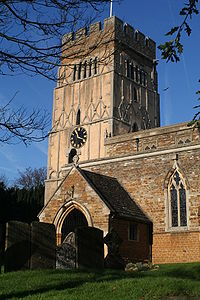
Architecture of the Anglo-Saxon period exists only in the form of churches, the simply structures commonly built in rock apart from fortifications. The earliest examples appointment from the seventh century, notably at Bradwell-on-Sea and Escomb, but the majority from the 10th and 11th centuries. Due to the systematic destruction and replacement of English cathedrals and monasteries by the Normans, no major Anglo-Saxon churches survive; the largest extant example is at Brixworth.
The main cloth is ashlar masonry, sometimes accompanied by details in reused Roman brick. Anglo-Saxon churches are typically high and narrow and consist of a nave and a narrower chancel; these are often accompanied by a west tower. Some feature porticus (projecting chambers) to the west or to the north and south, creating a cruciform program. Characteristic features include quoins in 'long-and-short piece of work' (alternate vertical and horizontal blocks) and small windows with rounded or triangular tops, deeply splayed or in groups of two or three divided past squat columns. The nigh common form of external ornamentation is lesene strips (sparse vertical or horizontal strips of projecting stone), typically combined with blind arcading. Notable examples of this exist at Earls Barton, Bradford-on-Avon and Barton-upon-Humber.
Norman architecture [edit]

In the 11th century the Normans were among Europe'due south leading exponents of Romanesque architecture, a style which had begun to influence English church edifice before 1066, simply became the predominant mode in England with the huge wave of construction that followed the Norman Conquest.[5] The Normans destroyed a big proportion of England's churches and built Romanesque replacements, a process which encompassed all of England's cathedrals. Most of the latter were afterwards partially or wholly rebuilt in Gothic mode, and although many withal preserve substantial Romanesque portions, simply Durham Cathedral remains a predominantly Romanesque construction (forth with St Alban'due south and Southwell, abbey churches in the medieval period). Even Durham displays significant transitional features leading towards the emergence of Gothic.[6] Romanesque churches are characterised by rounded arches, arcades supported by massive cylindrical piers, groin vaults and low-relief sculptural decoration. Distinctively Norman features include decorative chevron patterns.
In the wake of the invasion William I and his lords built numerous wooden motte-and-bailey castles to impose their control on the native population. Many were subsequently rebuilt in stone, beginning with the Tower of London. In that location are likewise a very small number of domestic Norman buildings still standing, for case Jew's House, Lincoln; manor houses at Saltford and Boothby Pagnall; and fortified manor houses such as Oakham Castle.[7]
Gothic architecture [edit]
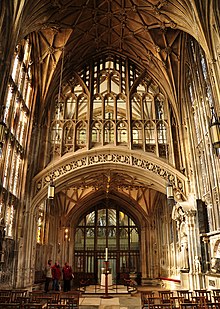
The major buildings of the Late Middle Ages and the first centuries of the Early Modern Menstruation were constructed in the predominant belatedly medieval European style of Gothic architecture. Art-historical periodisations are Early English language or First Pointed (belatedly 12th–late 13th centuries), Decorated Gothic or 2d Pointed (late 13th–late 14th centuries), and Perpendicular Gothic or Third Pointed (14th–17th centuries).[8] [9] The builder and art historian Thomas Rickman'due south Try to Discriminate the Style of Architecture in England, offset published in 1812, divided Gothic architecture in the British Isles into 3 stylistic periods.[10] Rickman identified the period of compages from William the Conquistador ( r. 1066–87) to Henry Ii ( r. 1154–89) as Norman; from Richard the Lionheart ( r. 1189–99) to Edward I ( r. 1272–1307) equally Early English; the reigns of Edward II ( r. 1307–27) and Edward III ( r. 1327–77) every bit Busy, and from Richard II ( r. 1377–99) to Henry VIII ( r. 1509–47) as Perpendicular.[10]
From the 15th century, under the Business firm of Tudor, the prevailing Gothic way is commonly known equally Tudor compages, existence ultimately succeeded past Elizabethan architecture and Renaissance architecture under Elizabeth I ( r. 1558–1603).[11] Rickman excluded from his scheme most new buildings subsequently Henry 8's reign, calling the style of "additions and rebuilding" in the subsequently 16th and earlier 17th centuries "often much debased".[10] Builder and fine art historian Edmund Sharpe published in 1851 The Seven Periods of English Architecture, in which he identified a pre-Gothic Transitional Period (1145–ninety) after the Norman menses, in which pointed arches and round arches were employed together.[12] Focusing on the windows, Sharpe dubbed Rickman's first Gothic style the Lancet Period (1190–1245); divided the 2nd into commencement the Geometrical (1245–1315) and and then the Curvilinear (1315–1360); and named the third style Rectilinear (1360–1550).[12]
This last Gothic style was typified by big windows, four-centred arches, direct vertical and horizontal lines in the tracery, and regular arch-topped rectangular panelling.[13] [14] Perpendicular was the prevailing style of Late Gothic architecture in England from the 14th century to the 17th century.[thirteen] [14] Perpendicular was unique to the country: no equivalent arose in Continental Europe or elsewhere in the British Isles.[xiii] Of all the Gothic architectural styles, Perpendicular was the first to experience a 2nd wave of popularity from the 18th century on in Gothic Revival architecture.[xiii]
Vernacular compages [edit]
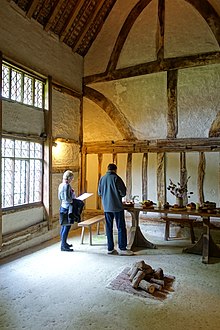
Little survives of the colloquial compages of the medieval period due to the apply of perishable materials for the bang-up majority of buildings. Virtually domestic buildings were built on timber frames, usually with wattle and daub infill. Roofs were typically covered with thatch; wooden shingles were besides employed, and from the twelfth century tile and slate came into use in some areas.[7] Also around the 12th century, the cruck frame was introduced, increasing the size of timber-framed colloquial buildings.[7] Typically, larger houses of this catamenia were based around a great hall open from floor to roof. One bay at each finish was divide into 2 storeys and used for service rooms and private rooms for the possessor.[fifteen] Even quite high up the social scale houses were small by mod standards, except for the very wealthy.[16]
Buildings surviving from this menstruation included moated manor houses of which Ightham Mote is a notable late medieval example, and Wealden hall houses such as Alfriston Clergy House. Tintagel Former Post Office is a 14th-century manor house in a role of the country where rock was the typical building fabric for improve houses. Little Moreton Hall, a big estate firm begun in 1504-08 and later on extended, is a famous showpiece of decorative half-timbering.[17] Near the dangerous Scottish border, the peel tower was a type of belfry business firm or pocket-sized castle; in Scotland they were even more than mutual. The bastle firm was a two-storey version, continuing what had been a common course of business firm for the better-off across the state in the late Anglo-Saxon and Norman periods.[eighteen]
Tudor transition [edit]
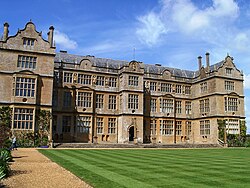
The Tudor period constitutes a transitional phase, in which the organic continuity and technical innovation of the medieval era gave way to centuries in which architecture was dominated by a succession of attempts to revive earlier styles.
The Perpendicular Gothic manner reached its culmination in the reign of Henry Seven and the early years of Henry 8, with the construction of King's College Chapel, Cambridge and Henry 7's Chapel at Westminster Abbey. Even so, the Reformation brought an effective halt to church-building in England which continued in most parts of the country until the 19th century.
By the time of Henry VII'southward accession castle-building in England had come up to an cease and nether the Tudors ostentatious unfortified country houses and palaces became widespread, built either in rock or in brick, which first became a mutual edifice material in England in this menstruum. Characteristic features of the early Tudor fashion included imposing gatehouses (a vestige of the castle), flattened pointed arches in the Perpendicular Gothic manner, foursquare-headed windows, decoratively shaped gables and large ornate chimneys. Outstanding surviving examples of early Tudor palatial compages include Hampton Court Palace and Layer Marney Tower.
Over the course of the 16th century Classical features derived from the Renaissance architecture of Italia exerted an increasing influence, initially on surface decoration but in time shaping the entire design of buildings, while the employ of medieval features declined. This evolution gave rise to deluxe stone dwellings or prodigy houses such equally Hardwick Hall and Montacute Business firm.
Style revivals [edit]
Stuart architecture [edit]

The Queen's House, Greenwich
During the 17th century the continuing accelerate of Classical forms overrode the eclecticism of English language Renaissance architecture, which gave way to a more than uniform way derived from continental models, chiefly from Italy. This entailed a retreat from the structural composure of Gothic architecture to forms derived from the more primitive construction methods of Classical antiquity. The mode was typified by foursquare or round-headed windows and doors, flat ceilings, colonnades, pilasters, pediments and domes. Classical architecture in England tended to exist relatively plain and simple in comparison with the contemporaneous Baroque architecture of the continent, being influenced above all by the Palladian manner of Italian republic. This was first introduced to England past Inigo Jones and typified by his Queen's Firm at Greenwich.
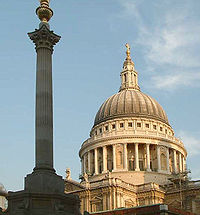
The Groovy Fire of London in 1666 forced the reconstruction of much of the city, which was the just part of the country to run across a pregnant corporeality of church-edifice between the Reformation and the 19th century. Sir Christopher Wren was employed to replace many of the destroyed churches, merely his master program for rebuilding London as a whole was rejected. Wren's churches exemplify the distinctive English approach to church-building in the Classical manner, which largely rejected the domes that typified the continental Bizarre and employed a wide range of unlike forms of steeple, experimental efforts to discover a substitute for the Gothic spire within a Classical mode. However, a dome featured very prominently in Wren'southward grandest structure, St Paul's Cathedral, the just English cathedral in whatever permutation of the Classical tradition.
The afterward 17th century saw Baroque architecture, a version of Classicism characterised past heavy massing and ostentatiously elaborate ornamentation, become widespread in England. Grand Baroque land houses began to appear in England in the 1690s, exemplified past Chatsworth House and Castle Howard. The virtually pregnant English Baroque architects after Wren were Sir John Vanbrugh and Nicholas Hawksmoor, who adapted the Baroque manner to fit English tastes in houses such as Blenheim Palace, Seaton Delaval Hall and Easton Neston.
Georgian compages [edit]
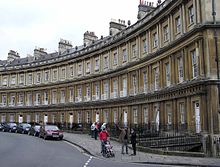
The 18th century saw a plow away from Baroque elaboration and a reversion to a more than austere approach to Classicism. This shift initially brought a render to the Italian Palladianism that had characterised the earliest manifestations of Classical compages in England. Later Neoclassical architecture increasingly idealised ancient Greek forms, which were viewed equally representing Classicism in its original 'purity', as against Roman forms. Country houses representing this style include Woburn Abbey and Kedleston Hall. This menstruation also saw the emergence of an increasingly planned approach to urban expansion, and the systematic, simultaneous structure of whole streets or squares, or even of unabridged districts, gave ascension to new forms of domestic structure, the terrace and the crescent, equally exemplified in Bath and in Bloomsbury and Mayfair in London. Among the notable architects practising in this era were Robert Adam, Sir William Chambers, John Wood and James Wyatt.
Victorian compages [edit]

The 19th century saw a fragmentation of English language compages, equally Classical forms continued in widespread use but were challenged by a series of distinctively English language revivals of other styles, cartoon importantly on Gothic, Renaissance and vernacular traditions but incorporating other elements as well. This ongoing historicism was counterposed past a resumption of technical innovation, which had been largely in abeyance since the Renaissance simply was now fuelled by new materials and techniques derived from the Industrial Revolution, peculiarly the use of iron and steel frames, and by the demand for new types of building. The rapid growth and urbanisation of the population entailed an immense amount of new domestic and commercial construction, while the aforementioned processes combined with a religious revival to bring almost a resumption of widespread church building. Mechanised manufacturing, railways and public utilities required new forms of building, while the new industrial cities invested heavily in grand borough buildings and the huge expansion and diversification of educational, cultural and leisure activities likewise created new demands on architecture.
The Gothic revival was a development which emerged in England and whose influence, except in church building edifice, was largely restricted to the English language-speaking globe. It had begun on a minor scale in the 18th century under the stimulus of Romanticism, a trend initiated by Horace Walpole'south house Strawberry Colina. However, widespread Gothic construction began only in the 19th century, led by the renewal of church building but spreading to secular construction. Early Gothic revival architecture was whimsical and unsystematic, only in the Victorian era the revival developed an abstract rigour and became a movement driven by cultural, religious and social concerns which extended far beyond compages, seeing the Gothic style and the medieval style of life as a road to the spiritual regeneration of social club. The start great ideologue of this movement was Augustus Welby Northmore Pugin, who together with Charles Barry designed the new Houses of Parliament, the grandest work of Victorian Gothic compages.
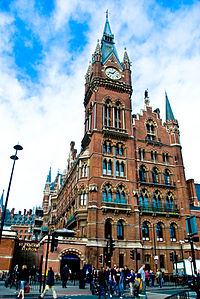
The Parliament building's Perpendicular style reflects the predominance of the subsequently forms of English language Gothic in the early on Victorian period, only this later gave way to a preference for plain Early English language or French Gothic, and to a higher place all to a way derived from the architecture of medieval Italia and the Low Countries. This Loftier Victorian Gothic was driven chiefly by the writings of John Ruskin, based on his observations of the buildings of Venice, while its archetypal practitioner was the church building architect William Butterfield. It was characterised past heavy massing, sparse use of tracery or sculptural ornament and an emphasis on polychrome patterning created through the use of unlike colours of brick and rock. The Gothic revival as well drove a widespread endeavour to restore deteriorating medieval churches, a do which ofttimes went beyond restoration to involve extensive reconstruction. The nigh active exponent of this activity was likewise the virtually prolific designer of new Gothic buildings, George Gilbert Scott, whose work is exemplified past St Pancras Station. Other leading Victorian Gothic architects included K. E. Street, J. F. Pearson and G. F. Bodley.
The Victorian menses saw a revival of interest in English vernacular building traditions, focusing chiefly on domestic architecture and employing features such every bit one-half-timbering and tile-hanging, whose leading practitioner was Richard Norman Shaw. This development too was shaped past much wider ideological considerations, strongly influenced by William Morris and the Arts and Crafts Movement. While its ethos shared much with the Gothic revival, its preoccupations were less religious and were connected with romantic socialism and a distaste for industrialisation and urban life. On the other hand, British industrial compages both revived old styles and developed new ones. In the later 19th century colloquial elements mingled with forms drawn from the Renaissance architecture of England and the Low Countries to produce a synthesis dubbed the Queen Anne Style, which in fact bore very picayune resemblance to the compages of that reign. While some architects of the menstruum were ideologically committed to a particular manner, a trend personified by Pugin, others were happy to motility between styles. An exemplar of this approach was Alfred Waterhouse, whose works included buildings in Romanesque, Gothic and Renaissance styles and eclectic fusions between them.

The Palm House at Kew Gardens, a key example of Victorian glasshouse construction
The new technology of iron and steel frame construction exerted an influence over many forms of edifice, although its apply was oftentimes masked past traditional forms. It was highly prominent in two of the new forms of building that characterised Victorian architecture, railway station railroad train sheds and glasshouses. The greatest exponent of the latter was Joseph Paxton, architect of the Crystal Palace.
In the 18th century a few English language architects had emigrated to the colonies, but equally the British Empire became firmly established in the 19th century many architects at the start of their careers made the decision to emigrate, several chose the United states of america but most went to Canada, Australia or New Zealand, as opportunities arose to meet the growing demand for buildings in these countries. Normally they adopted the style of architecture stylish when they left England, though by the latter half of the century, improving transport and communications meant that even quite remote parts of the Empire had access to many publications, such equally The Builder mag. This enabled colonial architects to stay beside of current style. Thus the influence of English language compages spread across the world. Several prominent 19th century architects produced designs that were executed by architects in the various colonies. For case, Sir George Gilbert Scott designed Bombay University & William Butterfield designed St Peter's Cathedral, Adelaide.
Historical styles in the 20th century [edit]
The last great exponent of belatedly Victorian free Renaissance eclecticism was Edwin Lutyens, and his shift into the Classical mode after 1900 symbolised a wider retreat from the stylistic ferment of the 19th century to a plainly and homogenous Classicism based on Georgian exemplars, an approach followed by many architects of the early 20th century, notably Herbert Baker and Reginald Blomfield. This Neo-Georgian style, while non greatly favoured in afterward decades by the architectural profession or architecture critics, has remained popular with clients and bourgeois commentators, notably Charles, Prince of Wales. Domestic architecture throughout the 20th century and across has continued to be strongly influenced by a homogenised version of Victorian vernacular revival styles. Some architects responded to modernism, and economic circumstances, by producing stripped-down versions of traditional styles; the piece of work of Giles Gilbert Scott illustrates this well.
Mod architecture [edit]
International Style [edit]
The International Fashion (also known every bit Modernism) emerged every bit a reaction confronting the world earlier the First World State of war, including historical architectural styles. Stylistically it was functional, cartoon upon objects that were designed for a specific purpose such as Oceanliners. It emerged as an idea from continental Europe, only was of involvement to some English architects. However it the arrival of emigre architects such as Mendelsohn and Lubetkin that galvanised the position of modern architecture within England.[19]
The bombing of English cities created a housing shortage, in the post war years. To meet this many thousands (maybe hundreds of thousands) of council houses in mock-vernacular way were built, giving working class people their first experience of private gardens and indoor sanitation. The demand was partly sated through the pre-fabrication of buildings within factories, giving rise to the "Pre-fab" .[20]
Brutalist architecture [edit]
The reconstruction that followed the Second Earth War had a major impact upon English architecture. The austerity that followed the WWII meant that toll dictated many design decisions, however significant architectural movements emerged. 1 such movement was the native evolution of Brutalism. Its expect was created though the desire to express how buildings were synthetic, for instance through the use of exposed concrete. Significant "New Brutalist" buildings were the Economist Building, the Hayward Gallery, the Barbican Arts Centre and the Royal National Theatre.

High-tech architecture [edit]
High-tech compages emerged as an attempt to revitalise the linguistic communication of Modernism, it drew inspiration from technology to create new architectural expression . The theorical work of Archigram provided meaning inspiration of the High-tec movement. Loftier-tech architecture is by and large associated with non-domestic buildings, perhaps due to the technological imagery. The two near prominent proponents were Richard Rogers and Norman Foster. Rogers' virtually iconic English language building is the Lloyd'due south building, situated nearby is Foster'southward most famous xxx St Mary Axe edifice (nicknamed The Gherkin). Their corresponding influence continues into the current century.
Postmodern compages [edit]
Postmodern architecture too emerged every bit an endeavour to enrich Modernistic architecture. Information technology was especially fashionable in the 1980s, when Modernism had fallen from favour, being associated with the welfare state. Many shopping malls and office complexes for case Broadgate used this style. Notable practitioners were James Stirling and Terry Farrell, although Farrell returned to modernism in the 1990s. A significant case of postmodernism is Robert Venturi's Sainsbury Wing of the National Gallery.
Contemporary compages [edit]
Significant recent buildings, in a variety of styles, include: Will Alsop: Peckham Library, North Greenwich tube station; David Chipperfield: River and Rowing Museum, Hepworth Wakefield; Future Systems: Lord'southward Media Centre, Selfridges Edifice, Birmingham; Zaha Hadid, London Aquatics Centre; Ian Simpson: Beetham Belfry, Manchester, Beetham Tower, Birmingham.
See also [edit]
- Compages of Wales
- Listing of historic buildings and architects of the Britain
- Listing of British architects
- Order of Architectural Historians of Slap-up Uk
- Category:Lists of Grade I listed buildings in England by county
- The Georgian Group
References [edit]
- ^ Davidson-Cragoe, Carol (2008). How to read buildings. London: Herbart Printing. ISBN978-0-7136-8672-ii.
- ^ Davies, John; Jenkins, Nigel; Baines, Menna; Lynch, Peredur, eds. (2008). The Welsh University Encyclopaedia of Wales. Cardiff: University of Wales Press. ISBN978-0-7083-1953-six.
The principal monuments of the Neolithic Age are megalithic tombs – the earliest surviving examples of compages in Britain
- ^ Davies, John (1994). A History of Wales. London: Penguin Books. p. 7. ISBN0-xiv-014581-eight.
Another revelation of carbon-14 is that there were fairly numerous communities of agriculturalists in Britain past 4000 BC ... There is a conflict of views apropos the relationship between the Mesolithic and the Neolithic peoples. Co-ordinate to one interpretation, the scanty Mesolithic population was swept aside ... According to another interpretation, the human relationship was highly creative, for it was in precisely those areas where the intrusive farmers met the ethnic population that architecture was born. The western extremities of Europe – Espana, Brittany, Uk and Republic of ireland – are dotted with megalithic structures normally known as cromlechi, although it should be remembered that to the archaeologist the cromlech is only one version of such structures. Information technology used to be assumed that the inspiration to build the cromlechi came from the Near East, but through some other of the revelations of carbon-14 it has been proved that they are the first substantial, permanent constructions of man and that the earliest of them are nearly 1500 years older than the showtime of the pyramids of Arab republic of egypt.
- ^ Stonehenge, Avebury and Associated Sites, UNESCO, retrieved 22 July 2011
- ^ Pragnall, Hubert (1984). Styles of English Architecture . Frome: Batsford. ISBN0-7134-3768-5.
- ^ Service, Alastair (1982). "6". Anglo-Saxon and Norman : A guide and Gazetteer. The Buildings of United kingdom. ISBN0-09-150130-X.
- ^ a b c Service, Alastair (1982). "4". Anglo-Saxon and Norman : A guide and Gazetteer. The Buildings of United kingdom. ISBN0-09-150130-X.
- ^ Schurr, Marc Carel (2010), Bork, Robert E. (ed.), "fine art and compages: Gothic", The Oxford Lexicon of the Middle Ages, Oxford University Printing, doi:10.1093/acref/9780198662624.001.0001, ISBN978-0-19-866262-4 , retrieved nine Apr 2020,
Early to High Gothic and Early English language (c.1130–c.1240) Rayonnant Gothic and Decorated Style (c.1240–c.1350) Late Gothic: flamboyant and perpendicular (c.1350–c.1500)
- ^ Curl, James Stevens; Wilson, Susan, eds. (2015), "Gothic", A Lexicon of Architecture and Landscape Architecture (3rd ed.), Oxford Academy Press, doi:ten.1093/acref/9780199674985.001.0001, ISBN978-0-19-967498-5 , retrieved nine April 2020,
Kickoff Pointed (Early on English language) was used from the end of C12 to the end of C13, though most of its characteristics were nowadays in the lower part of the chevet of the Abbey Church of St-Denis, nearly Paris (c.1135–44). ... In one case First Pointed evolved with Geometrical tracery it became known as Middle Pointed. 2nd-Pointed piece of work of C14 saw an always-increasing invention in bar-tracery of the Curvilinear, Flowing, and Reticulated types, ... culminating in the Flamboyant mode (from c.1375) of the Continent. Second Pointed was relatively brusque-lived in England, and was superseded past Perp[endicular] (or Third Pointed) from c.1332, although the ii styles overlapped for some fourth dimension.
- ^ a b c Rickman, Thomas (1848) [1812]. An Attempt to Discriminate the Styles of Compages in England: From the Conquest to the Reformation (5th ed.). London: J. H. Parker. pp. lxiii.
- ^ Roll, James Stevens; Wilson, Susan, eds. (2015), "Tudor", A Dictionary of Architecture and Landscape Architecture (3rd ed.), Oxford University Press, doi:10.1093/acref/9780199674985.001.0001, ISBN978-0-19-967498-v , retrieved 9 April 2020
- ^ a b Sharpe, Edmund (1871) [1851]. The 7 Periods of English Architecture Divers and Illustrated. London: E. & F. North. Spon. p. eight.
- ^ a b c d Ringlet, James Stevens; Wilson, Susan, eds. (2015), "Perpendicular", A Dictionary of Compages and Mural Architecture (third ed.), Oxford University Printing, doi:ten.1093/acref/9780199674985.001.0001, ISBN978-0-19-967498-5 , retrieved 16 May 2020
- ^ a b Fraser, Murray, ed. (2018), "Perpendicular Gothic", Sir Banister Fletcher Glossary, Regal Institute of British Architects and the Academy of London, doi:10.5040/9781350122741.1001816, ISBN978-1-350-12274-one , retrieved 26 Baronial 2020,
English idiom from about 1330 to 1640, characterised by large windows, regularity of ornate detailing, and grids of panelling that extend over walls, windows and vaults.
- ^ Quiney, Anthony (1989). Flow Houses, a guide to authentic architectural features. London: George Phillip. ISBN0-540-01173-8.
- ^ Aslet and Powers, fifteen
- ^ Aslet and Powers, 13-15, 40
- ^ Aslet and Powers, xx-24
- ^ Curtis, William.j.r (1996). Modern architecture since 1900. London: Phaidon. ISBN0-7148-3356-8.
- ^ Weston, Richard (2002). The House in the 20th Century. London: Laurence Rex Publishing Ltd. ISBN1-85669-219-1.
- Aslet, Clive and Powers, Alan, The National Trust book of the English Firm Penguin/Viking, 1985, ISBN 0670801755
External links [edit]
DOWNLOAD HERE
Posted by: mulliganwroody.blogspot.com
Post a Comment